
No products in the cart.
Industrial Air Compressor Buying Guide: CFM, PSI and Duty Cycle
Practical industrial air compressor buying guide for shops and plants. Compare CFM, PSI, duty cycle, storage, air treatment, power, controls, and lifecycle cost.
 Written byHarfanTools Editorial Team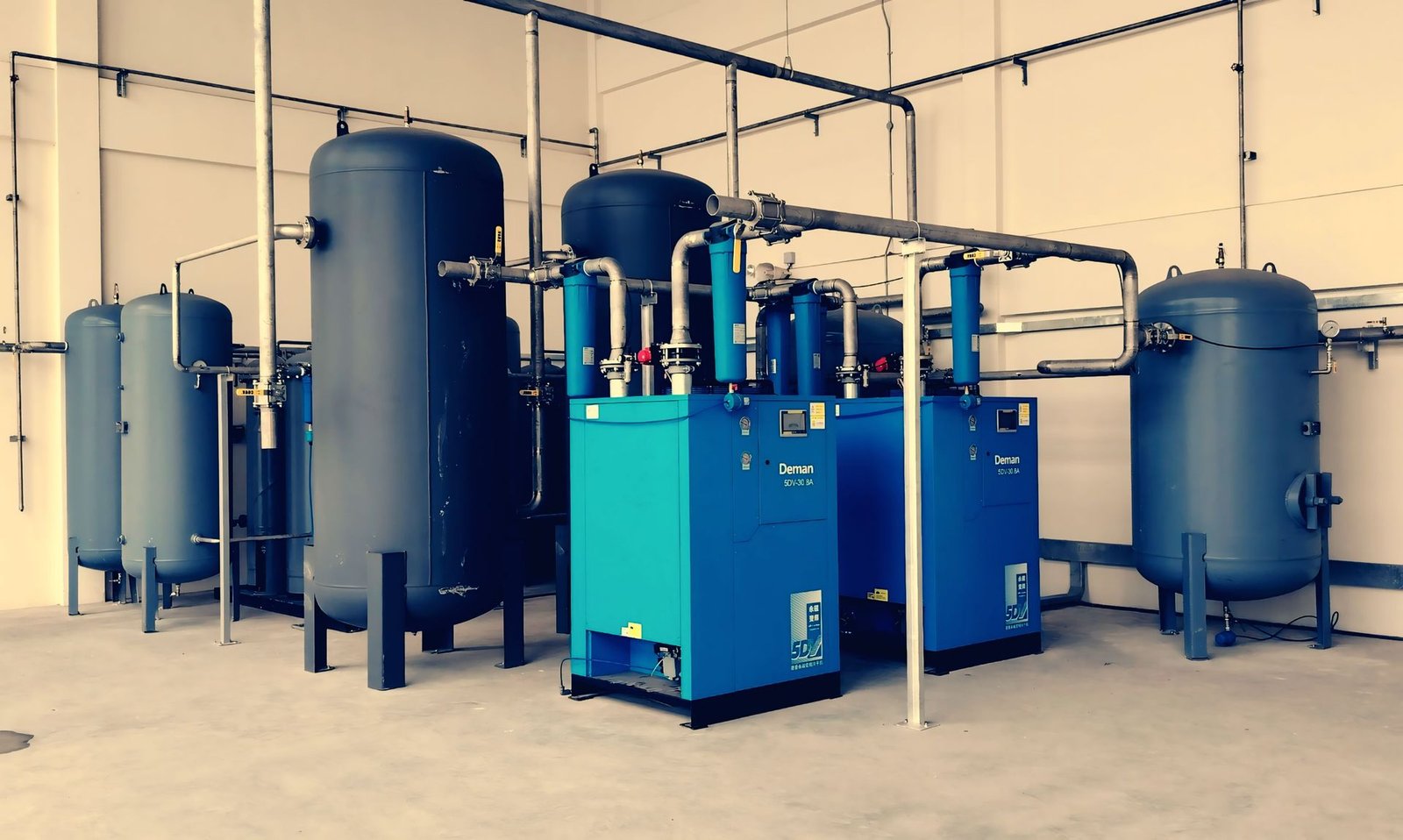
Quick answer: choose an industrial air compressor by defining three requirements first: peak air demand in CFM, minimum pressure at the point of use in PSI, and required air quality. Then match the compressor type, storage, dryer, electrical supply, controls, and service plan to the way your shop or plant actually operates.
An industrial air compressor is a long-term production asset, not just a larger version of a portable compressor. An undersized system can lose pressure during peak demand and run excessively. An oversized or poorly controlled system can waste energy and increase maintenance costs. The goal is to select a complete compressed-air system that delivers the required flow and pressure reliably at the lowest practical lifecycle cost.
Editorial method: the HarfanTools Editorial Team prepared this guide using current product specifications and guidance from the Compressed Air & Gas Institute (CAGI), the U.S. Department of Energy, and OSHA. Products were not laboratory-tested for this guide; always have the final system sized and installed by a qualified compressed-air supplier and licensed electrical professional.
The Three Numbers to Define Before You Shop
CAGI identifies demand, pressure, and air quality as the three parameters that should be defined before compressed-air equipment is selected. Start with the process, not horsepower or tank size.
1. Peak air demand (CFM or SCFM)
Record the rated air consumption of every tool, machine, and process that may run at the same time. Use the rating at the required pressure; a CFM number without its pressure rating is incomplete. Account for actual duty cycle, simultaneous use, leakage, short demand spikes, and reasonable future expansion.
For example, suppose two tools can each consume 5 SCFM at 90 PSI while a production fixture consumes 12 SCFM continuously. The known simultaneous requirement is 22 SCFM at 90 PSI before measured leakage, pressure losses, or planned expansion are considered. Do not select a compressor from nominal horsepower alone—compare delivered capacity at the pressure your equipment needs.
Use our detailed air compressor CFM sizing guide to build a demand worksheet. For a production facility with changing shifts or large intermittent loads, a logged demand profile is more reliable than a single estimate.
2. Minimum operating pressure (PSI)
Identify the highest minimum pressure required at the point of use, not only at the compressor outlet. Filters, dryers, undersized piping, long hose runs, fittings, and simultaneous flow all create pressure drop. Raising the entire system pressure to compensate for a local restriction is usually a poor substitute for correcting that restriction.
3. Required air quality
Define acceptable moisture, oil aerosol, and particle levels for each process. General shop tools may tolerate air that would be unsuitable for painting, instrumentation, electronics, food processing, or other sensitive applications. An oil-free compressor reduces the risk of lubricant entering the compression chamber, but it does not remove ambient moisture or particles; filtration and drying may still be required.
Our refrigerated vs. desiccant air dryer guide explains how required dew point and operating conditions affect dryer selection.
Industrial Air Compressor Selection Table
| Operating profile | Typical starting point | Why it may fit | Verify before purchase |
|---|---|---|---|
| Intermittent repair or fabrication work | Reciprocating compressor | Lower initial cost and suitable for demand with recovery periods | Allowed duty cycle, noise, vibration, tank recovery, and peak CFM |
| Sustained production demand | Rotary screw compressor | Continuous delivery and controls designed for longer operating periods | Load profile, part-load efficiency, ventilation, controls, and service support |
| Large, stable process demand | Centrifugal system | Can serve very high, relatively steady flow requirements | Specialist engineering, turndown, redundancy, cooling, and air treatment |
| Demand that changes substantially by shift | Properly sized compressor system with storage and coordinated controls | Controls and storage can respond to changing demand more effectively than nameplate capacity alone | Measured load profile, minimum pressure, receiver location, and control strategy |
| Sensitive product or process | System selected around required air-quality class | Compressor, filters, dryer, drains, and piping are treated as one system | Required dew point, particles, oil, monitoring, and applicable industry rules |
Reciprocating vs. Rotary Screw vs. Centrifugal
Reciprocating compressors
A reciprocating compressor uses one or more pistons. It is often a practical choice for workshops with intermittent demand and enough off-time for recovery. Check the manufacturer’s duty-cycle rating rather than assuming every piston unit can run continuously.
Rotary screw compressors
A rotary screw compressor uses meshing rotors to provide continuous flow. It commonly suits production environments with sustained demand, but efficiency depends on proper sizing and control at both full and partial load. A machine that spends long periods unloaded can be expensive to operate even if its nameplate capacity looks impressive.
Centrifugal compressors
Centrifugal compressors are dynamic machines generally considered for very large, relatively stable industrial demand. Selection, controls, cooling, and system integration require specialist engineering.
For a closer comparison of the two most common shop and plant options, see rotary screw vs. reciprocating air compressors.
Seven Decisions That Determine the Right System
1. Build a realistic load profile
List end uses by shift and identify what runs continuously, intermittently, or simultaneously. Include production equipment, blow-off, cleaning, controls, and expected expansion. For an existing facility, measure flow, pressure, and power over representative production periods. The U.S. Department of Energy recommends evaluating how demand changes over time because facilities with varying demand may benefit from different controls or storage strategies.
2. Choose capacity at the required pressure
Compare manufacturer performance data at your required discharge pressure and site conditions. Do not use horsepower as a substitute for delivered CFM. Confirm ambient temperature, altitude, inlet conditions, and cooling requirements with the supplier because they can affect available capacity.
3. Treat the receiver tank as storage—not extra compressor capacity
An air receiver can buffer short peaks, stabilize pressure, help separate condensate, and reduce rapid cycling in appropriate systems. It cannot supply a continuous demand that exceeds compressor output indefinitely. Tank volume should be selected with the demand pattern and control strategy, not from a universal gallons-per-horsepower rule.
Read the 20 vs. 60 vs. 80 gallon air compressor tank guide for common shop-size tradeoffs.
4. Verify electrical service and starting requirements
Confirm voltage, phase, frequency, full-load current, starting method, disconnects, and available panel capacity. Three-phase power is common for larger industrial motors, but availability varies by facility. Installation should follow the equipment manual and applicable electrical codes.
Use our single-phase vs. three-phase compressor checklist before requesting an electrical quote.
5. Plan ventilation, piping, drainage, and service access
Provide the clearances, airflow, and cooling specified by the manufacturer. Route intake air away from heat and contamination where practical. Size distribution piping for expected flow and acceptable pressure drop, provide condensate management, and leave safe access for filters, belts, oil service, drains, and major component removal.
6. Compare controls and part-load operation
Ask how the proposed compressor behaves when demand is below full capacity. Load/unload, modulation, variable-speed, sequencing, and system-level controls behave differently. A variable-speed drive can be useful where demand varies within the machine’s efficient operating range, but it does not correct poor sizing or eliminate the need for system analysis.
7. Compare lifecycle cost and local support
Request comparable quotes that identify delivered capacity, pressure, motor power, controls, dryer and filter pressure drop, maintenance intervals, consumables, warranty, and commissioning. Consider electricity, routine service, replacement parts, downtime risk, and technician availability—not only purchase price.
Worked Example: Small Manufacturing Shop
Assume a shop has one production fixture using 12 SCFM continuously at 90 PSI and two hand tools rated at 5 SCFM each that can operate together. Its documented simultaneous demand is 22 SCFM at 90 PSI. The buyer should then:
- Measure or estimate leakage and pressure loss through the dryer, filters, piping, and hose.
- Add only justified expansion capacity rather than an arbitrary oversized margin.
- Compare delivered SCFM at the required pressure—not displacement CFM or horsepower.
- Decide whether the load is intermittent enough for a properly rated reciprocating unit or sustained enough to justify a rotary screw system.
- Have the supplier verify storage, treatment, electrical service, ventilation, and controls as a complete system.
This example is a planning method, not a final equipment specification. A measured load profile is preferable for an operating plant.
Common Buying Mistakes
- Sizing from horsepower: horsepower does not tell you delivered capacity at the required pressure.
- Adding every nameplate CFM without considering simultaneous use: this can oversize the system, while ignoring actual peak combinations can undersize it.
- Using higher system pressure to hide pressure drop: correct restrictions and distribution problems first.
- Assuming a large receiver replaces compressor output: storage only supports demand for a limited time.
- Ignoring air treatment: dryers, filters, separators, and drains must match the process and operating environment.
- Buying without a service plan: confirm maintenance access, parts availability, response time, and responsibility for commissioning.
Safety and Compliance Check
Follow the compressor, receiver, dryer, and electrical manufacturers’ installation and maintenance instructions and all applicable local requirements. In U.S. workplaces, OSHA 29 CFR 1910.242(b) addresses compressed air used for cleaning: it generally requires pressure at the cleaning nozzle to be reduced below 30 PSI and requires effective chip guarding and personal protective equipment. This limit concerns cleaning use; it is not the normal operating-pressure limit for production tools.
Industrial Air Compressor Buying Checklist
- Peak and average CFM demand documented by shift
- Minimum PSI defined at the most demanding point of use
- Required dew point, particle level, and oil control identified
- Compressor type matched to operating profile and duty
- Receiver, dryer, filters, drains, and controls sized as a system
- Voltage, phase, starting current, and electrical installation verified
- Ventilation, intake conditions, piping, drainage, and service clearances planned
- Part-load performance and control strategy compared
- Energy, maintenance, parts, warranty, and downtime included in the cost comparison
- Final selection reviewed by qualified supplier and electrical professionals
Related Air Compressor Guides
- How Much CFM Does an Air Compressor Need?
- Rotary Screw vs. Reciprocating Air Compressor
- Air Compressor Tank Size: 20 vs. 60 vs. 80 Gallon
- Refrigerated vs. Desiccant Air Dryer
- Single-Phase vs. Three-Phase Air Compressor
- Commercial Air Compressors for Automotive Shops
Browse Industrial Air Compressors
Once your demand, pressure, air quality, and electrical requirements are documented, compare available air compressors at HarfanTools. Confirm delivered CFM, pressure, duty rating, included treatment equipment, electrical requirements, warranty, and suitability with the manufacturer or a qualified supplier before ordering.
Frequently Asked Questions
How much CFM does an industrial air compressor need?
It needs enough delivered CFM at the required pressure to cover the realistic peak combination of tools and processes, plus measured leakage and justified expansion. Use manufacturer performance data at your operating pressure and verify the result with a qualified supplier.
Is a rotary screw compressor always better than a piston compressor?
No. Rotary screw units often suit sustained production demand, while reciprocating units can be economical for intermittent shop use. The better choice depends on load profile, duty rating, controls, air quality, maintenance, and lifecycle cost.
Does a larger tank increase compressor CFM?
No. A larger receiver stores more compressed air and can buffer short peaks, but it does not increase the compressor’s sustained output.
Does oil-free mean the air needs no filtration or drying?
No. Oil-free refers to the compression process. Ambient moisture and particles still need to be controlled according to the end use, so filters and a dryer may still be necessary.
Technical References
- Compressed Air & Gas Institute: Working With Compressed Air
- U.S. Department of Energy: Compressed Air Resources and Sourcebook
- OSHA 29 CFR 1910.242: Compressed Air Used for Cleaning
HarfanTools product guidance
Need help choosing industrial equipment?
Compare professional tools, review specifications and find equipment suited to your operation.


5 Comments