No products in the cart.
Forklift Capacity Guide: How to Read a Load Chart
Understand forklift load centers, data plates, lift height, attachments, stability, derating and safe capacity planning.
 Written byHarfanTools Editorial Team
forklift capacity guide explains why the number printed on a truck is not a universal lifting limit. Rated capacity applies at a specified load center, mast configuration, height, and attachment. Longer, taller, offset, or irregular loads can reduce safe capacity dramatically.
Warehouse and industrial teams in the US, Canada, and Asia should use the exact manufacturer data plate and local operator rules. This article supports equipment planning; it does not replace a capacity plate, engineering approval, or trained operator.
Forklift Capacity Guide: Factors That Change Capacity
| Decision factor | What to check |
|---|---|
| Load center | Greater horizontal distance increases overturning moment. |
| Lift height | Capacity may fall as mast height increases. |
| Attachment | Weight and forward offset require a revised data plate. |
| Load shape | Long or uneven loads need specific evaluation. |
1. Rated Capacity Is Conditional
A truck described as 5,000 lb or 2,500 kg is rated under conditions shown on its data plate. The plate should identify load center, lift height, mast, tire configuration, attachments, and other limitations. Operators must use the plate installed on that truck.
Never assume two visually similar forklifts have the same residual capacity. Model, mast, counterweight, tires, carriage, and attachment can change the result.
2. Understand the Load Center
Load center is the horizontal distance from the fork face to the load center of gravity. A uniformly distributed 48-inch-deep load has a nominal 24-inch center. A deeper or forward-shifted load creates more overturning moment and reduces available capacity.
Real loads may have an offset center of gravity. Machinery, coils, tanks, and long materials require more than a pallet assumption.
3. Read Every Line on the Data Plate
Locate the truck model and serial number, rated capacity, load center, maximum height, mast specification, attachment, tire type, and warnings. If the plate is damaged, unreadable, or does not match the installed configuration, remove the truck from that lift until corrected.
Only the manufacturer or authorized qualified party should provide revised capacity information after modifications.
4. Account for Attachments and Carriage Weight
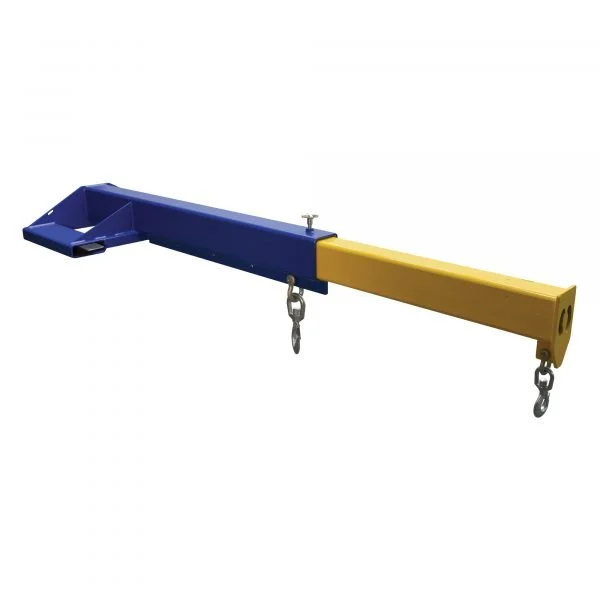
Side shifters, fork positioners, clamps, rotators, booms, and extensions add weight and often move the load forward. Both effects reduce residual capacity. Fork extensions also require correct support and load placement.
Do not subtract attachment weight from headline capacity as the only calculation. Geometry matters, and the revised plate is the controlling reference.
5. Consider Lift Height, Mast, and Travel
A truck may carry a load low but have a lower rating at full height. Mast deflection, visibility, aisle width, floor condition, ramps, wind, and dynamic forces influence the operating plan.
Travel with the load low and stable, follow site speed rules, avoid turning on grades, and maintain clearance from edges and pedestrians.
6. Match Truck Type to the Facility
Capacity is only one selection factor. Compare aisle width, lift height, surface, indoor emissions, charging or fuel infrastructure, duty cycle, attachments, and service support. Counterbalance, reach, rough-terrain, and telehandler designs serve different environments.
For imported or multi-region equipment, confirm local certification, labels, units, and training requirements.
Forklift Load Planning Checklist
- Read the exact truck data plate.
- Measure load weight and center of gravity.
- Confirm attachment on the capacity plate.
- Check capacity at required lift height.
- Inspect forks, tires, mast, and hydraulics.
- Plan route, aisle, ramp, and pedestrian controls.
- Use a trained and authorized operator.
Frequently Asked Questions
Can forklift capacity be calculated from a formula?
A moment calculation can illustrate why capacity changes, but safe operation must use the manufacturer-approved data plate for the exact configuration.
Do fork extensions reduce capacity?
They can change load placement and leverage. Use only approved extensions and follow the truck and extension limitations.
What happens when the load center increases?
The overturning moment increases, so available load weight generally decreases. Obtain approved residual-capacity data.
Trusted Resources and Next Steps
Review the OSHA powered industrial truck guidance and use the capacity plate for the exact machine.
Bottom line: Treat forklift capacity as configuration-specific, verify load center and lift height, and never operate from a generic chart when the data plate is available. Browse the forklift and material-handling range, or visit the HarfanTools knowledge center for more equipment guides.
Forklift Capacity Rules and Units by Region
US workplaces should follow OSHA requirements, while Canadian operations must follow the rules of their province or territory and applicable CSA practices. Training, inspection, and site procedures are jurisdiction-specific, but the truck’s data plate remains the controlling source for rated capacity. Never convert a catalog number into permission to lift; attachments, mast height, load center, tire condition, and uneven floors can all reduce the safe operating margin.
Across Asia, capacity may be shown in kilograms and load-center distances in millimeters rather than pounds and inches. Convert units carefully and use the plate fitted to the exact truck, not a similar online model. Imported attachments should be included in an updated capacity assessment by the manufacturer or qualified supplier. Battery voltage, charger compatibility, fuel availability, emissions rules, aisle width, and local technician coverage also influence which forklift will remain productive and compliant.
HarfanTools product guidance
Need help choosing industrial equipment?
Compare professional tools, review specifications and find equipment suited to your operation.