No products in the cart.
Drill Press vs Magnetic Drill: Which Machine Fits the Job?
Compare a drill press and magnetic drill by workpiece size, portability, workholding, annular cutters, steel thickness, feed control, and safety.
 Written byHarfanTools Editorial Team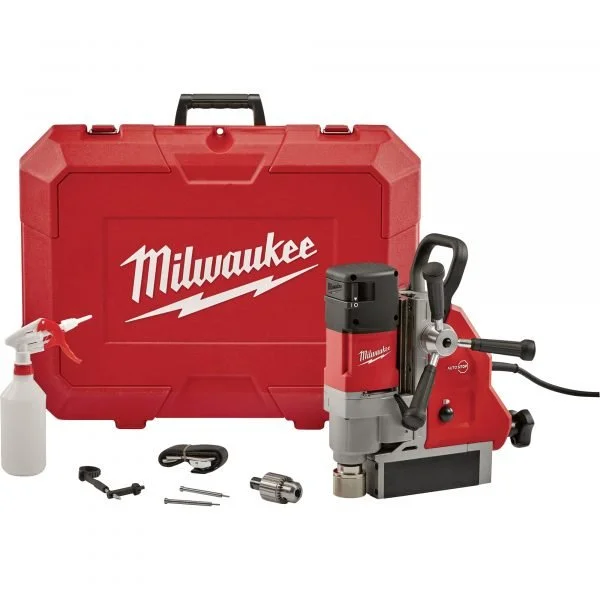
drill press vs magnetic drill is a choice between bringing the work to a fixed spindle and bringing the spindle to ferrous steel. A drill press offers a stable table and broad shop versatility; a magnetic drill is built for portable holemaking where its electromagnet can attach securely.
A magnetic base requires suitable material, thickness, flatness, cleanliness, and uninterrupted power. It does not safely grip every stainless alloy, thin sheet, painted surface, curved member, or nonferrous workpiece without an approved alternative setup.
Quick answer: Choose a drill press for bench or floor work that can be clamped to its table and needs repeatable general drilling. Choose a magnetic drill for large installed ferrous workpieces that meet the base requirements, especially when annular cutters improve hole speed and finish.
The drill press vs magnetic drill decision depends first on whether the work can move safely to the machine or the machine must move to the work.
Drilling Platform Comparison
| Decision | Drill press | Magnetic drill |
|---|---|---|
| Work movement | Workpiece goes to the machine | Machine goes to the workpiece |
| Holding | Vise or clamps on a table | Electromagnetic base plus safety restraint |
| Common tooling | Twist drills, countersinks, accessories | Annular cutters and approved twist-drill setup |
| Material constraint | Table capacity and clamping | Magnetic adhesion and base geometry |
1. Start With Workpiece Geometry
A drill press throat, spindle travel, table size, and column clearance limit the work it can accept. A magnetic drill reaches beams, plates, and structures that cannot be placed on a table.
For a mag drill, verify a flat mounting area large enough for the full base. Curvature, scale, rust, coatings, chips, and thin stock can reduce holding force.
2. Choose the Correct Cutting Tool
Annular cutters remove a ring of material rather than the full hole cross-section and can cut large holes efficiently. Match cutter diameter, depth, shank, pilot, lubricant, and machine speed range.
Twist drilling requires suitable chuck or arbor capacity and torque. Never exceed the model maximum cutter or drill size.
3. Secure Against Movement
Clamp work firmly on a drill press; hands are not workholding devices. For a magnetic drill, use the manufacturer safety chain or strap even when the magnet appears strong.
Vertical, overhead, or confined use can add falling-object and hot-chip hazards. Follow exact orientation limits and site controls.
4. Check Speed, Feed, and Lubrication
Large cutters and hard materials generally require controlled speed, feed, and cutting fluid. Excessive speed burns edges; too little feed can rub and harden the work.
Use the cutter supplier chart and machine gearbox range. Clear long chips only after stopping the spindle with tools intended for chip handling.
5. Plan Power and Access
A magnetic drill must maintain electrical power to preserve holding force unless its design states otherwise. Use approved cords, ground-fault protection where applicable, and a secured route.
A drill press needs floor stability, guarding, lighting, and clearance for stock. In both cases, plan the full hole location before energizing.
Machine Selection Checklist
- Measure workpiece size and hole location.
- Identify material magnetic properties and thickness.
- Choose hole diameter, depth, finish, and tooling.
- Confirm machine capacity, speed, stroke, and arbor.
- Design approved workholding and safety restraint.
- Plan coolant, chips, power, and access.
- Test setup on representative material when possible.
Mistakes That Lead to a Poor Purchase
- Using a mag drill on a surface with inadequate holding force.
- Holding drill-press work by hand.
- Skipping the magnetic drill safety strap.
- Running an annular cutter at an unsuitable speed or without required lubrication.
Frequently Asked Questions
Can a magnetic drill work on stainless steel?
Only if the alloy and workpiece provide adequate magnetic attraction or the manufacturer approves a special mounting solution. Many stainless grades are weakly magnetic or nonmagnetic.
Is a mag drill more accurate than a drill press?
Accuracy depends on setup, spindle condition, cutter, feed, surface, and workholding. Each can be precise in its intended application.
Can a magnetic drill be used upside down?
Only when the exact manual permits the orientation and all required restraint, lubrication, and worksite controls are used.
Sources and Buying Next Step
For this drill press vs magnetic drill guide, manufacturer or government guidance provides the technical baseline. Always let the exact equipment manual, nameplate, applicable electrical code, and local safety requirements control the final decision.
Bottom line: Choose the drill around workpiece movement and approved workholding; portability is useful only when the magnetic base can be secured correctly. Browse the magnetic drill selection to compare real specifications after completing the checklist above.
HarfanTools product guidance
Need help choosing industrial equipment?
Compare professional tools, review specifications and find equipment suited to your operation.