Multi Process Welder Buying Guide: 9 Best Checks

Choose a multi-process welder using processes, amperage, duty cycle, input power, materials, feeders, portability, safety and service.

Multi Process Welder Buying Guide: 9 Best Checks

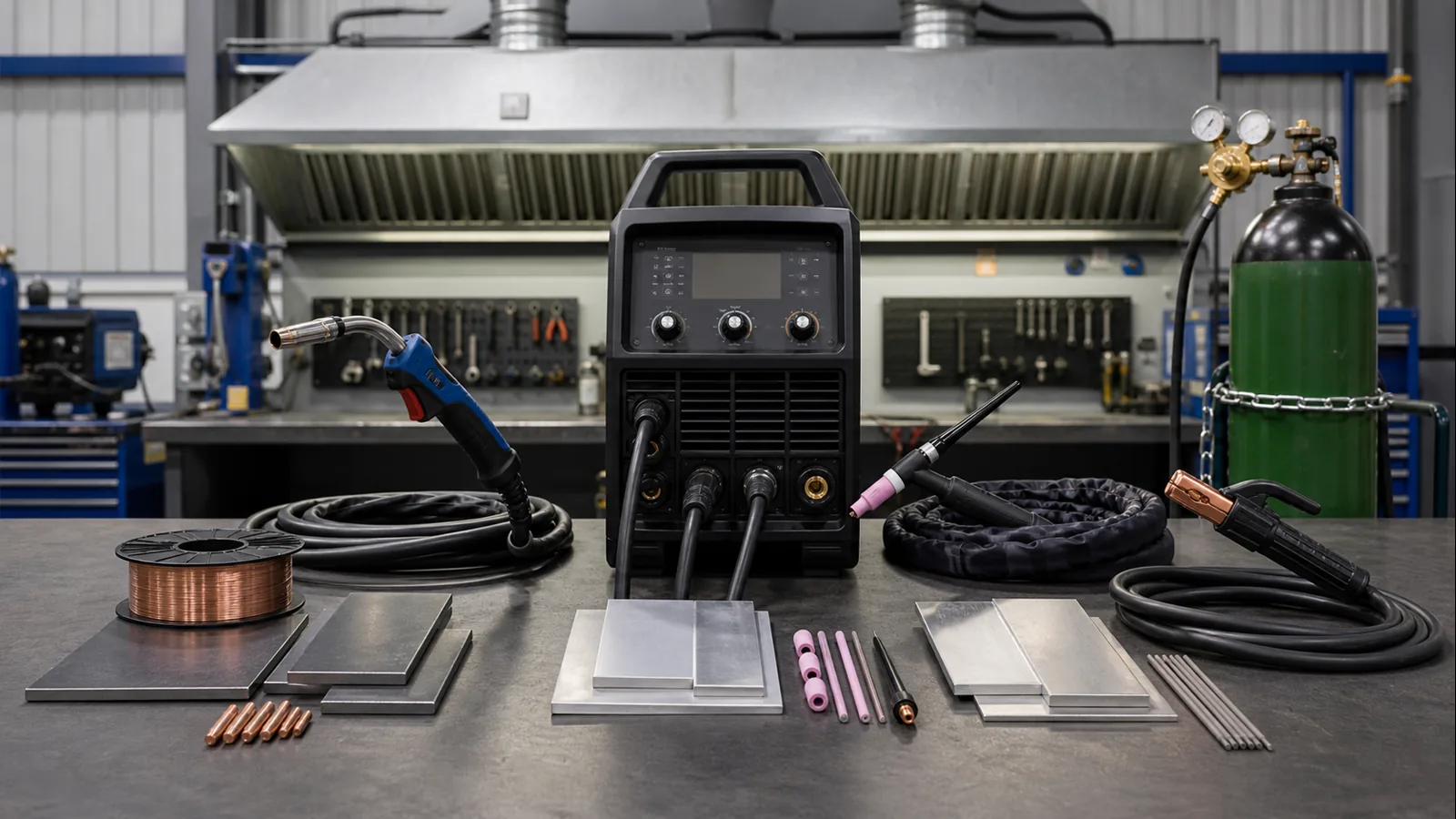
multi process welder buying guide helps a fabrication shop decide whether one power source can cover its real MIG, flux-cored, Stick, and TIG workload without unacceptable compromises. “Multi-process” describes a feature set; it does not guarantee every process has the controls, output, polarity, or accessories required for production.
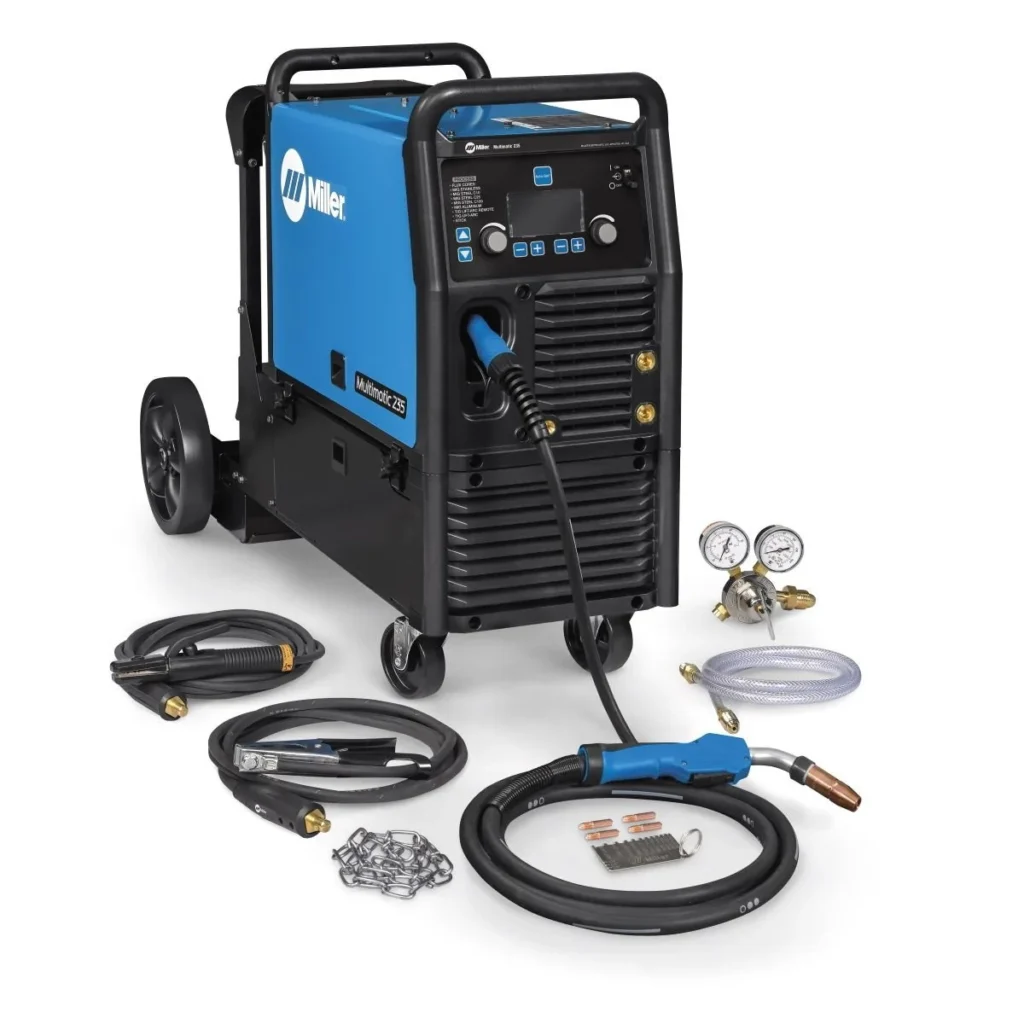
Miller Multimatic 235 Multi-Process Welder w/ Running Gear — example equipment relevant to multi process welder buying guide
Miller Multimatic 235 Multi-Process Welder w/ Running Gear — view product

Specify base metals, thickness, joint positions, deposition target, finish, code, input power, duty cycle, feeder distance, shielding gas, portability, and operator skill. US, Canadian, and Asian buyers must verify the exact regional voltage and included package.

multi process welder buying guide: Quick Answer

Choose a machine that excels at the shop’s dominant process and adequately supports secondary work. Confirm output at the required duty cycle, single- or three-phase input, AC/DC TIG needs, pulse functions, feeder and gun compatibility, included accessories, local certification, ventilation, and service.

Decision factorBest-fit guidanceVerify before buying
General steel fabricationMIG/flux-cored priorityFeeder, voltage range, and duty cycle.
Field repairStick plus portable wire capabilityGenerator compatibility and enclosure.
Stainless precision workDC TIG controlsLow-amp start, pulse, and gas control.
Aluminum fabricationAC TIG or spool/push-pull MIGExact process and accessory support.

1. Define the Primary and Secondary Processes

List annual hours and critical quality requirements for MIG/GMAW, flux-cored/FCAW, Stick/SMAW, and TIG/GTAW. Choose for the dominant process first; a machine used 80 percent for production MIG should have the feeder and arc controls that job needs.

Check whether TIG is lift-arc, high-frequency, DC only, or AC/DC; whether MIG supports pulse; and whether polarity change is manual or automatic. Marketing process counts can hide major capability differences.

2. Match Amperage to Material and Joint

Record base metal, filler, thickness, joint, position, preheat, travel speed, and required fusion. Maximum amperage alone is not enough; stable low-end output matters for thin material and root control.

Use qualified procedures or supplier trials for code work. Produce samples across the normal range and inspect penetration, profile, spatter, distortion, and repeatability.

3. Compare Duty Cycle at the Required Output

Duty cycle states how long the machine can weld within a defined period at a stated amperage and ambient condition. Compare ratings at the output actually needed, not each model’s different headline point.

High ambient heat, restricted airflow, dust, long leads, and input voltage can affect operation. Run a full production cycle and record thermal interruptions.

4. Verify Input Voltage, Phase, and Generator Use

Confirm nominal voltage, allowable range, phase, frequency, breaker, conductor, plug, and power-factor or inrush requirements. Auto-line capability can simplify mixed sites but still has limits.

For generator operation, use manufacturer minimum kVA or wattage and power-quality requirements. A plug adapter does not correct voltage, frequency, grounding, or phase.

5. Select Wire Feeders, Guns, and TIG Accessories

Compare internal versus remote feeders, spool-gun and push-pull support, wire diameter, drive rolls, gun length, torch cooling, foot or hand controls, electrode holder, work lead, and remote amperage control.

Price the package required to weld on day one. A low base-unit price can become expensive after proprietary feeders, torches, carts, coolers, and cables.

6. Plan Shielding Gas and Consumables

Confirm local availability and cost of wire, electrodes, filler rods, contact tips, liners, nozzles, cups, tungsten, drive rolls, gas, regulators, and cooling fluid. Standardize consumables where it does not compromise procedure.

Protect filler and electrodes from moisture and contamination. Separate stainless and aluminum preparation tools from carbon-steel contamination.

7. Evaluate Portability and Work Environment

Record source-to-joint distance, stairs, confined areas, outdoor wind, rain, dust, heat, and vehicle transport. Lightweight machines improve mobility, but feeder placement and cable length can matter more than power-source weight.

Verify enclosure rating and never use unsuitable electrical equipment in wet conditions. Stick and self-shielded flux-cored processes tolerate wind better than gas-shielded MIG or TIG, but still require correct procedure and ventilation.

8. Control Fumes, Radiation, Fire, and Electrical Risk

Welding creates fumes, gases, ultraviolet radiation, sparks, heat, noise, and electrical hazards. OSHA requires suitable ventilation in specified conditions and local exhaust near the source when necessary.

Assess base metal and coatings before work, remove combustibles, provide screens and PPE, inspect leads and grounds, secure gas cylinders, and plan confined-space rescue where applicable.

9. Test Service, Software, and Total Cost

Review warranty territory, technician training, boards, fans, feeders, displays, firmware, calibration, error logs, and loaner availability. Confirm that local service supports the exact regional model.

Calculate power, gas, consumables, rework, maintenance, downtime, training, accessories, and resale. A reliable arc and stocked tip often create more value than a feature used twice a year.

How to Compare multi process welder buying guide Options Objectively

Start with a written duty profile instead of a brand shortlist. Record the property or workpiece, normal and peak workload, operating hours, access limits, available utilities, climate, operator experience, and the result that must be achieved. For this multi process welder buying guide decision, the most useful quotation is one that states its assumptions and identifies every included battery, charger, cord, blade, bit, accessory, guard, transfer device, or consumable.

Compare ratings at the same operating point. Maximum values are often measured under conditions that do not represent a full shift, tall wet grass, reinforced concrete, thick steel, motor starting current, or repeated production cycles. Ask for continuous output, duty cycle, runtime at a stated load, recharge or refuel time, environmental derating, service intervals, and the exact test method behind any noise, vibration, capacity, or efficiency claim.

Then run a representative acceptance test. Use the regular operator, typical material or turf, the accessories that will be used in production, and enough time to expose heat, battery, filtration, traction, or duty-cycle limits. Record setup time, productive time, interruptions, finish quality, consumable wear, energy or fuel use, and operator feedback. A short controlled test makes multi process welder buying guide comparisons more defensible than a catalog specification alone.

Finally, calculate total ownership cost. Include purchase price, freight, tax or duty, installation, batteries, chargers, fuel, electricity, approved accessories, wear parts, maintenance labor, training, storage, downtime, and expected resale value. Confirm who performs warranty work and how quickly common parts can reach the site. The lowest initial price is not automatically the lowest cost per acre, hole, cut, weld, or delivered kilowatt-hour.

multi process welder buying guide for the United States, Canada and Asia

United States buying notes

US shops should verify input service, electrical listing, OSHA ventilation and PPE requirements, gas supply, and procedure qualification. Many small shops use single-phase power while production sites may use three-phase; never assume a high-output unit fits the existing panel.

Canada buying notes

Canadian buyers should verify recognized certification, CCOHS electrical guidance, cold storage, regional gas and consumable supply, and Canadian warranty. Imported US packages may have different plugs, labels, manuals, or approval status.

Asia buying notes

Asian workshops range from 100 V single-phase locations to 220–240 V single-phase and larger three-phase plants, at 50 or 60 Hz. Confirm the exact input range, plug, phase, local certification, high-temperature duty, gas availability, consumables, manual language, and technician coverage. Singapore’s WSH Act explicitly covers welding equipment among regulated machinery and equipment.

Do not treat an imported listing as proof of local compatibility. Confirm the exact model suffix, voltage, frequency, plug or outlet, certification mark, emissions status, warranty territory, parts channel, and manual language. Asia is not one electrical or regulatory market: for example, Japan uses 100 V and both 50 Hz and 60 Hz regions, while many Southeast Asian installations use approximately 220–240 V at 50 Hz. The machine name can remain the same while its motor, charger, receptacles, firmware, or compliance package changes.

Nine-Step Multi-Process Welder Checklist

  1. Rank primary and secondary welding processes.
  2. Define materials, thicknesses, joints, and codes.
  3. Compare duty cycle at required amperage.
  4. Verify voltage, phase, frequency, and circuit.
  5. List feeders, guns, torches, and controls.
  6. Confirm gas and consumable availability.
  7. Test portability in the real work area.
  8. Specify ventilation, PPE, fire, and electrical controls.
  9. Run sample welds and calculate lifecycle cost.

Keep the completed checklist with the quotation, product data, acceptance record, and maintenance baseline. This gives the next buyer or technician evidence of why the equipment was selected and which assumptions must be revisited when the workload changes.

Frequently Asked Questions About multi process welder buying guide

Is a multi-process welder good for beginners?

It can consolidate equipment, but the operator still needs training in each process, setup, hazards, and joint quality. Simple controls are not a substitute for procedure.

Can one welder do MIG, TIG, and Stick equally well?

Usually one or two processes are stronger. Verify TIG start and AC capability, MIG feeder features, Stick electrodes, duty cycle, and included accessories.

Do I need AC TIG for aluminum?

AC TIG is commonly used to weld aluminum because it supports oxide cleaning. Aluminum MIG may instead use a spool gun or push-pull feeder when the machine approves it.

What duty cycle is enough?

Match it at the amperage and ambient condition of the real production cycle. A high percentage at low output may not cover heavy welding.

Can a portable generator run a multi-process welder?

Only when generator capacity, waveform, voltage, frequency, grounding, and welder requirements are compatible. Get written manufacturer guidance.

Trusted Resources and HarfanTools Next Steps

Review OSHA welding ventilation requirements, CCOHS electric tool guidance, and Singapore MOM machinery and welding equipment responsibilities. Compare HarfanTools welding equipment, the MIG vs TIG vs Stick guide, and metal fabrication tools.

Bottom line: Select a welder that is excellent at the dominant process, verified at the required duty and input power, and supported with the complete feeder, torch, consumable, safety, and service package.

Final Review of multi process welder buying guide

Before approving a multi process welder buying guide decision, compare the written requirement with the supplier quotation line by line. Confirm the exact regional model, capacity at the intended duty, included accessories, safety controls, utilities, warranty territory, service contact, and acceptance test. Any exception should be recorded and resolved before payment or deployment.

The strongest multi process welder buying guide recommendation also identifies who will operate, inspect, maintain, and store the equipment. Give that team the manual, baseline settings, approved consumables, spare-parts list, inspection frequency, and escalation path. Review the multi process welder buying guide file after commissioning and again after the first major service interval so measured operating data can improve the next purchase.

Multi process welder buying guide: regional procurement workbook

A high-confidence purchase comes from a documented job test, not a feature-count contest. Use this workbook after reading the comparison above. It turns the multi process welder buying guide decision into evidence that a homeowner, contractor, buyer, or safety lead can review later. The objective is to choose the smallest practical system that completes repeatable MIG, TIG, or stick work across the materials, thicknesses, positions, and duty cycles actually encountered without transferring hidden cost or risk to the operator.

1. Write a one-page job profile before requesting prices

Record the material or site, task frequency, maximum continuous session, access restrictions, storage conditions, available power or fuel, operators, transport limits, and acceptable downtime. Add the worst normal condition—not an extreme misuse case—so the shortlist is not built around an easy demonstration. For this multi-process welder, the useful measures are arc starts, bead consistency, amperage and duty-cycle behavior, changeover time, fume-capture effectiveness, input-current demand, and consumable usage. Keep units consistent and take notes during the same work cycle.

Separate a requirement from a preference. A requirement is a gate width, input voltage, minimum hole diameter, runtime, safety control, or locally available wear part that determines whether the equipment can do the job. A preference is color, an unused mode, or a theoretical maximum that does not affect the route. This distinction prevents a premium option from disguising a poor operational fit.

2. Score the shortlist with weighted evidence

Decision factorSuggested weightEvidence to collectReject when
Job performance30%Timed trial on representative workThe core task needs workarounds
Safety and exposure control20%Manual, guards, controls, placement, PPE and local assessmentA required control is missing or impractical
Serviceability15%Written parts list, dealer response and repair pathCritical wear parts have no reliable source
Operating fit15%Access, transport, storage, power and weather checkThe unit does not fit the real environment
Total cost15%Three-year cost model with downtimeAssumptions depend on missing prices or unrealistic life
Operator acceptance5%Structured feedback after equal trialsControls cannot be used consistently

Score every row from one to five, multiply by its weight, and attach the evidence. Adjust weights before—not after—the trial if a factor is genuinely more important. A transparent worksheet makes a multi process welder buying guide recommendation easier to challenge and improve without relying on memory.

3. Adapt the test for the United States, Canada, and Asia

United States field note

For US shops, match input power, overcurrent protection, process capability, and ventilation to the real work. OSHA welding controls and the equipment manual should shape the workstation and fume plan. Check the current product manual, safety notices, and applicable workplace or electrical requirements for the exact use.

Canada field note

For Canada, include CCOHS-aligned electrical inspection, cylinder handling, ventilation, and cold-storage considerations. Confirm local torches, liners, tips, electrodes, gas fittings, and authorized service. Confirm bilingual documentation, approved electrical components where applicable, and a support route that operates in the province or territory.

Asia field note

For Asian workshops, verify local voltage and frequency, grounding arrangements, heat, humidity, consumable supply, gas availability, and service coverage. Confirm requirements for the specific country and facility. Asia is not one electrical or regulatory market; document the destination country, facility rules, grid conditions, language needs, and authorized service before ordering.

These regional notes are screening prompts, not substitutes for local law, an equipment manual, or a site risk assessment. If a supplier cannot answer a region-specific compatibility question in writing, treat that uncertainty as a cost and risk rather than assuming the machine will work.

4. Run a controlled acceptance trial

  1. Inspect the unit, accessories, guards, labels, connectors, serial number, and manual before energizing or starting it.
  2. Use the same operator, route, material, measurement method, and safe work procedure for each candidate where practical.
  3. Record baseline conditions, including temperature, moisture, task dimensions, load, battery state, fuel level, or supply voltage as relevant.
  4. Complete a normal work cycle. Do not defeat a guard, overload the machine, or improvise a connection to make a candidate pass.
  5. Log output quality, time, interruptions, consumables, exposure controls, operator comments, and remaining energy or fuel.
  6. Repeat any surprising result. A single fast run is not enough evidence for a fleet or household backup decision.
  7. Document defects and supplier responses before acceptance, then retain the worksheet with purchase and warranty records.

Pay special attention to electric shock, fumes, fire, cylinder hazards, input-power mismatch, duty-cycle shutdown, poor changeover discipline, and unavailable consumables. The best multi process welder buying guide choice is the one that controls these foreseeable problems while meeting the real duty cycle. An impressive no-load demonstration does not prove production performance or safe integration.

5. Compare three-year cost, not only checkout price

Build a simple annual model for power source, torches and leads, feeder parts, gas equipment, extraction, PPE, wire or electrodes, electricity, setup labor, inspection, and downtime. Use local quotes, measured consumption, the planned number of work cycles, and the organization’s real labor rate. Keep tax, freight, finance, and resale assumptions visible. For batteries or high-wear components, model a reasonable replacement case and a stress case instead of promising a fixed life.

Downtime deserves its own line. Estimate lost production or the cost of a rental, backup unit, delayed job, spoiled material, or missed service window. Then ask the supplier for current stock and lead time on the five parts most likely to stop work. This often changes a multi process welder buying guide ranking more than a small difference in purchase price.

6. Questions that deserve written answers

  • Which exact configuration was quoted, including model, voltage, battery, charger, guard, accessory, and country version?
  • What task limits, duty cycle, environment, storage range, and maintenance intervals does the manual specify?
  • Which consumables and safety-critical parts are locally stocked, and what are their current lead times?
  • Who performs warranty diagnosis and repair, and what evidence is required to support a claim?
  • What operator training, inspection record, or commissioning check is recommended?
  • Which claim in the proposal comes from a controlled test, and which is only an estimate?

Save the completed worksheet and revisit it after 30 and 90 days. Compare forecast runtime, output, consumable use, incidents, and downtime with actual results. That feedback closes the loop: the next multi process welder buying guide purchase starts with site evidence instead of repeating an assumption.

HarfanTools expert support

Need help choosing industrial equipment?

Compare professional tools, review specifications and find equipment suited to your operation.
Leave a Reply

Your email address will not be published. Required fields are marked *