
No products in the cart.
Lawn Mower Deck Size Guide: 8 Best Sizing Rules
Choose mower deck width using acreage, gates, obstacles, terrain, trailer size, cut quality, horsepower and weekly workload.
 Written byHarfanTools Editorial Team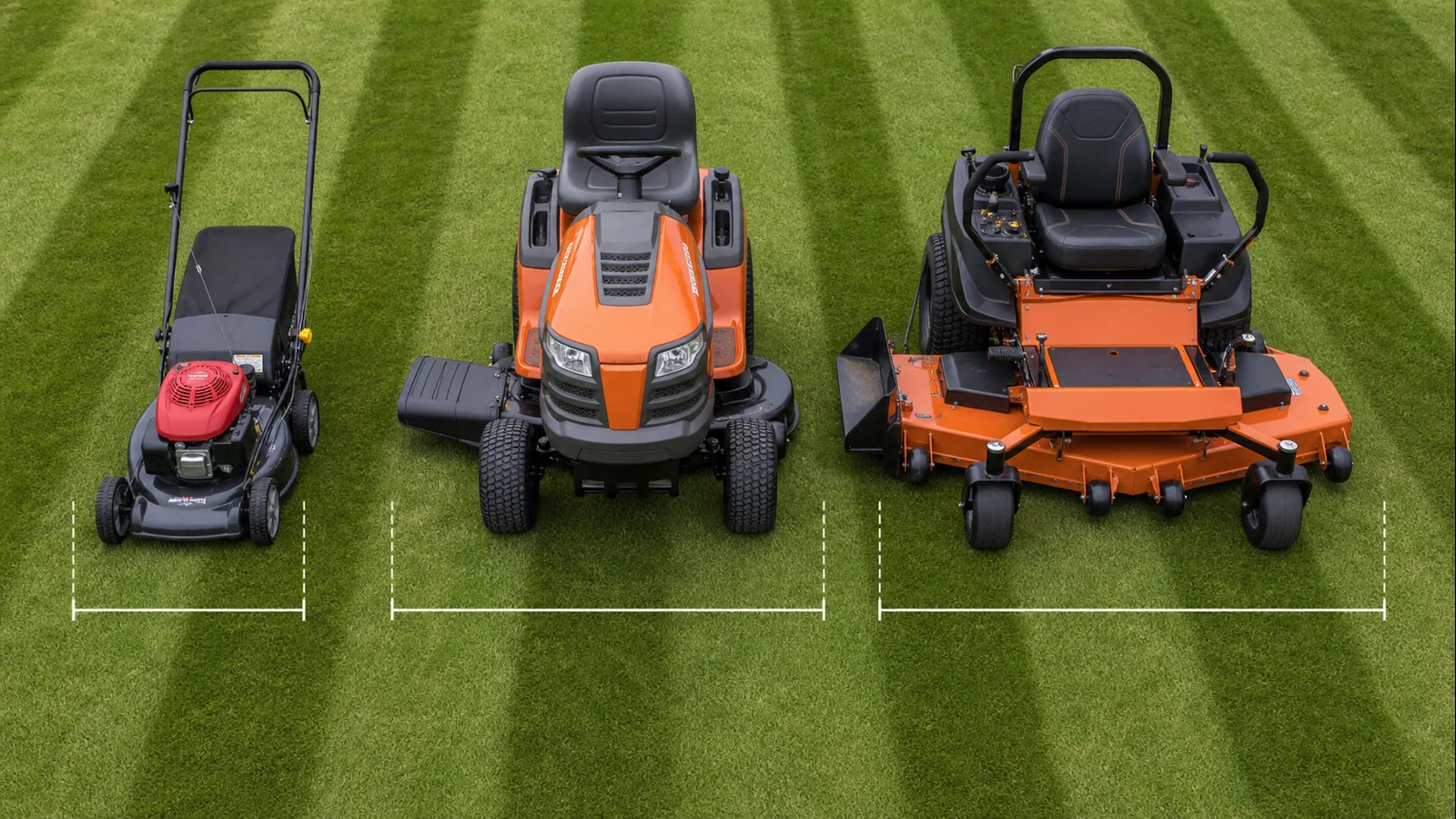
lawn mower deck size guide helps buyers choose a cutting width that saves passes without creating access, scalping, transport, or power problems. Wider is productive on open level turf; narrower can deliver a better result on rolling ground and complicated landscapes.
The decision must connect mowable acreage to the narrowest gate, smallest turning zone, trailer and storage width, engine or motor capacity, grass load, terrain, and expected finish. These constraints apply to properties in the US, Canada, and Asia even though common lot layouts and climate differ.
lawn mower deck size guide: Quick Answer
Measure the tightest access first, then size for the largest open mowing zone. Around 21–30 inches suits walk-behind work; 42–48 inches is common for compact riding properties; 50–54 inches balances access and productivity on many larger lawns; 60 inches and above works best on open acreage with suitable transport, power, and ground contour.
| Decision factor | Best-fit guidance | Verify before buying |
|---|---|---|
| 21–30 in | Walk mowing and constrained access | Operator effort, gates, and daily area. |
| 42–48 in | Compact residential riding use | Gate width, obstacles, and slopes. |
| 50–54 in | Medium-to-large mixed properties | Trailer width and uneven terrain. |
| 60+ in | Open acreage and commercial routes | Power, transport, scalping, and discharge. |
1. Measure Mowable Acreage, Not Lot Acreage
Exclude buildings, paving, ponds, beds, woods, and other areas the mower never enters. Divide the remaining turf into open zones, obstacle-heavy zones, slopes, and narrow connectors. A property with two mowable acres split among courtyards can need a different deck than two open acres.
Estimate weekly peak growth and desired completion time. Deck width reduces the number of passes, but usable speed and turning efficiency determine actual productivity.
2. Find the Narrowest Gate and Transport Point
Measure gate clear opening, posts, hinges, latches, curbs, ramps, shed doors, trailer rails, and tie-down clearance. Use the mower’s total operating width with discharge chute and accessories—not only nominal deck width.
Leave practical clearance for steering and tire variation. A deck that fits on paper may be frustrating when every passage requires folding a chute or approaching perfectly.
3. Match Width to Obstacles and Turning Space
Trees, beds, signs, play equipment, irrigation, and building corners reduce the value of a wide deck. More width may shorten open passes but increase trimming or prevent clean turns at row ends.
Map the tightest island and test whether the mower can complete a turn without reversing or damaging turf. Zero-turn steering improves maneuverability but does not shrink the physical deck.
4. Account for Terrain and Scalping Risk
A wide rigid deck spans more high and low points, increasing the chance of scalping crowns or missing depressions. Anti-scalp wheels, deck suspension, rollers, and a flexible cutting system help, but cannot fully correct a width that is poorly matched to the ground.
Walk the site and mark crests, drainage swales, roots, and abrupt transitions. A narrower deck can sometimes mow uneven ground faster because it requires fewer corrective passes.
5. Verify Engine Power and Blade Tip Performance
A wider deck drives more blade length and processes more grass per second. Thick, wet, or fast-growing turf increases the load. Compare engine displacement, torque behavior, cooling, blade count, belt design, and manufacturer-approved deck pairing.
Do not select by horsepower alone. The same rating can perform differently because of deck airflow, blade speed, gearing, and power losses. Test peak grass while maintaining a clean discharge.
6. Compare Cut Quality and Clipping Management
Deck depth, baffles, blade overlap, vacuum, discharge opening, mulching kit, and ground speed shape the finish. A productive commercial deck should distribute clippings without windrows and retain adequate suction as conditions change.
Inspect the result from several directions. Check stragglers, ridges between blades, scalping, clumps, and debris thrown toward people or property. Reduce speed before blaming width alone.
7. Check Trailer, Storage, and Service Access
A wider mower may require a different trailer, ramp, storage bay, lift, or service stand. Measure total width, wheelbase, height with rollover protection, length with bagger, and turning room inside storage.
Confirm that blades, spindles, belts, grease points, wash ports, and deck-removal hardware remain accessible. A deck that saves minutes mowing can lose those savings if routine service is slow.
8. Calculate Productivity with Real Efficiency
Theoretical capacity equals width multiplied by speed, but real efficiency is reduced by overlap, turns, obstacles, emptying, refueling, and terrain. Time a known area or model realistic field efficiency rather than assuming full-width cutting every minute.
Commercial buyers should compare labor saved against additional machine, trailer, fuel, and service cost. A second compact mower can sometimes outperform one oversize machine on fragmented routes.
How to Compare lawn mower deck size guide Options Objectively
Start with a written duty profile instead of a brand shortlist. Record the property or workpiece, normal and peak workload, operating hours, access limits, available utilities, climate, operator experience, and the result that must be achieved. For this lawn mower deck size guide decision, the most useful quotation is one that states its assumptions and identifies every included battery, charger, cord, blade, bit, accessory, guard, transfer device, or consumable.
Then run a representative acceptance test. Use the regular operator, typical material or turf, the accessories that will be used in production, and enough time to expose heat, battery, filtration, traction, or duty-cycle limits. Record setup time, productive time, interruptions, finish quality, consumable wear, energy or fuel use, and operator feedback. A short controlled test makes lawn mower deck size guide comparisons more defensible than a catalog specification alone.
lawn mower deck size guide for the United States, Canada and Asia
United States buying notes
Large suburban and commercial properties often reward 50–60 inch decks, but gated backyards and landscaped islands remain limiting. Verify transport width, rollover protection, emissions status, and dealer support. Follow CPSC riding mower guidance and the exact manufacturer slope limits.
Canada buying notes
Northern seasonal growth can create dense spring loads, while freeze-thaw conditions may leave uneven turf. Include trailer use, winter storage, corrosion cleanup, and spring parts availability. A wide deck that scalps frost-heaved ground may not deliver the expected labor saving.
Asia buying notes
Many Asian estates, resorts, campuses, and urban landscapes combine fast tropical growth with narrow paths, drainage, soft monsoon ground, and ornamental obstacles. Prioritize access, flotation, deck cleaning, corrosion protection, and parts supply before maximum width.
Eight-Step Lawn Mower Deck Size Checklist
- Measure actual mowable area.
- Record every gate and narrow passage.
- Map obstacles and turning zones.
- Inspect crowns, swales, roots, and slopes.
- Confirm engine or motor capacity.
- Test clipping management in peak grass.
- Verify trailer, storage, and service clearance.
- Calculate realistic field productivity.
Frequently Asked Questions About lawn mower deck size guide
What deck size is best for one acre?
A 42–48 inch riding deck is a common starting point, while a 21–30 inch walk mower can suit compact or obstacle-heavy layouts. Access and terrain can matter more than acreage.
Is a 60-inch mower too big for residential use?
It may be suitable for open acreage, but gates, landscaping, trailer width, storage, turf contour, and operator control must support it.
Does a wider deck always mow faster?
No. Wider decks reduce passes on open ground but can lose time at obstacles, gates, uneven terrain, transport, and trimming.
How much wider is the mower than its deck size?
Total width varies with tires, guards, and discharge chute position. Use the manufacturer overall-width dimension and measure the exact configuration.
Do wider decks need more horsepower?
Generally they require more power to maintain blade speed under load, but deck design, blade count, gearing, turf, and ground speed also matter.
Trusted Resources and HarfanTools Next Steps
Use the CPSC riding mower safety resource and the exact model manual. Compare the zero turn mower collection, riding lawn mowers, and the detailed zero turn mower buying guide.
Bottom line: Choose the widest deck that safely fits every critical access point, follows the ground without unacceptable scalping, has adequate power, and fits transport and service infrastructure.
HarfanTools product guidance
Need help choosing industrial equipment?
Compare professional tools, review specifications and find equipment suited to your operation.
One Comment